
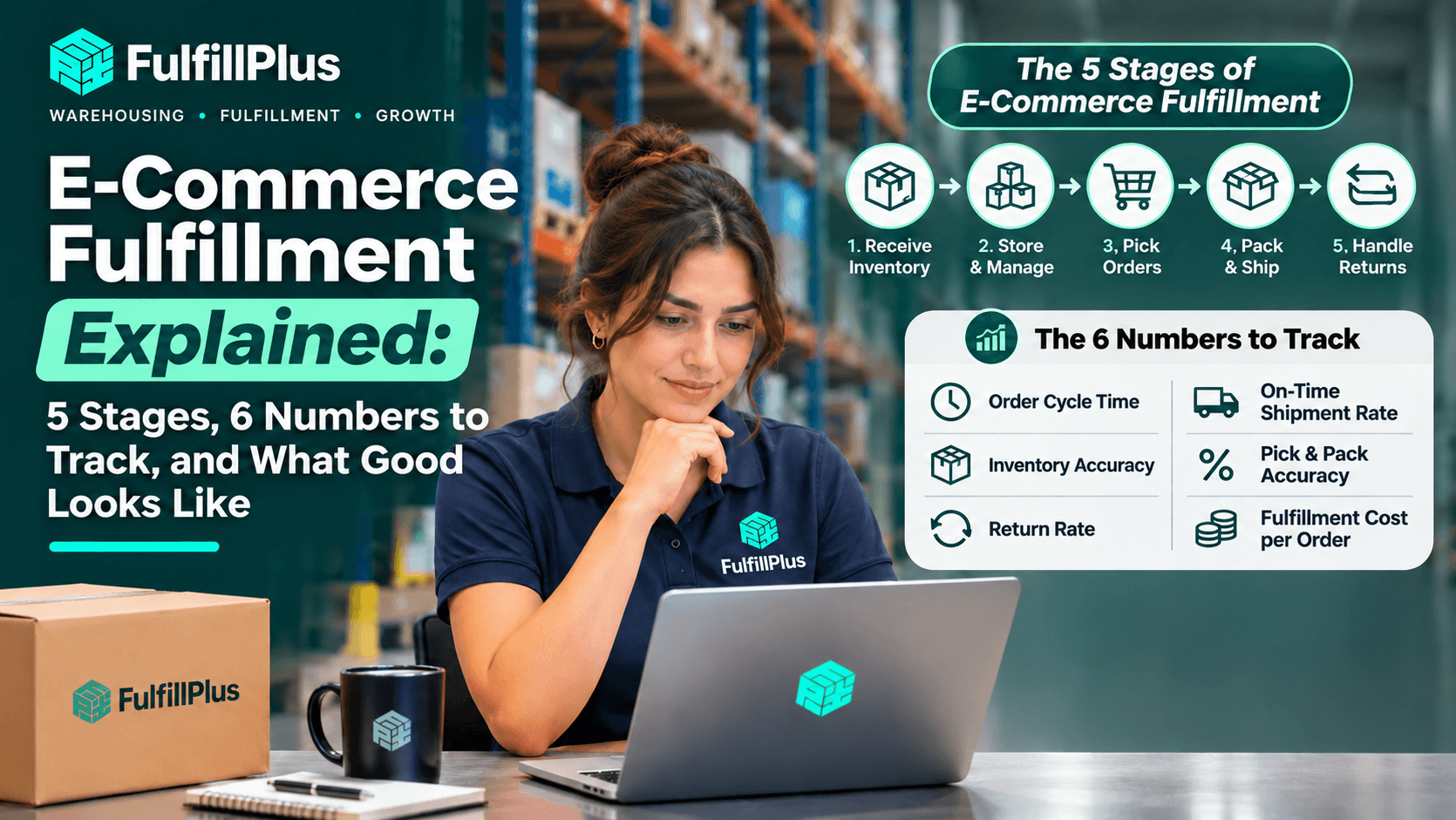
E-Commerce Fulfillment Explained: 5 Stages, 6 Numbers to Track, and What Good Looks Like
E-commerce fulfillment is everything that happens between a customer clicking Buy and the package arriving at their door, plus what happens if it comes back. It covers receiving and storing inventory, processing the order, picking and packing it, shipping it, and handling returns.
Most guides stop at that list. The harder question is whether each step is actually working, and you can answer it with numbers. This guide walks through the five stages of e-commerce fulfillment, the six numbers that show how each one is performing, and the benchmarks to hold yourself, or a fulfillment partner, to.
What e-commerce fulfillment includes
Brands handle e-commerce fulfillment in a few ways. Some pack orders themselves. Some hire a third-party logistics provider (3PL) to do it. Some send inventory to a marketplace program such as Fulfillment by Amazon. The stages are the same in every case. What changes is who is responsible for each one, and whether you can see the numbers.
The five stages at a glance
| Stage | What happens | What goes wrong | Number to watch |
|---|---|---|---|
| 1. Receiving and storage | Inventory arrives, is counted, and is put away | Stock sits on the dock, or the counts don’t match the system | Dock-to-stock time, inventory accuracy |
| 2. Order processing | The order reaches the warehouse and is verified | Orders wait past the daily cutoff | Order cycle time |
| 3. Picking and packing | Items are picked, packed, and labeled | Wrong item, wrong quantity, damage | Order accuracy |
| 4. Shipping and delivery | A carrier takes the package to the customer | Late handoff to the carrier, long transit | On-time shipping rate |
| 5. Returns | The return is received, inspected, and restocked or discarded | Returned items sit unprocessed while stock shows as unavailable | Return processing time |
Stage 1: Receiving and storage
Fulfillment starts when your inventory reaches the warehouse. The team counts it against your shipping notice, checks for damage, scans it into the warehouse system, and assigns it a storage location. If this step goes wrong, every later step inherits the error. A miscount here becomes an oversold item or a backorder later.
Two numbers tell you how well receiving is working.
Dock-to-stock time is how long inventory takes to go from arriving at the dock to being available to sell. One 3PL metrics guide lists 48 hours as standard performance and under 24 hours as what top performers achieve. Slow put-away creates stockouts your customers feel but your inventory report doesn’t show, because the stock is physically in the building and not yet sellable.
Inventory accuracy is how closely the system’s count matches a physical count. Sources put the common target at 98% or higher, and some at 99% or higher.
Stage 2: Order processing
When a customer places an order, it syncs from your store to the warehouse system, which checks that stock is available and flags anything unusual, such as a bad address. This stage should be nearly invisible.
Order cycle time is the time from the customer’s order to the package being shipped. A common target is under 24 to 48 hours, and same-day shipping for orders received before a daily cutoff is the top tier. Whatever the target, ask what the cutoff is. An order placed at 3 p.m. may ship tomorrow or the day after, and your delivery promise depends on knowing which.
Stage 3: Picking and packing
This is where most customer-facing mistakes happen. A picker pulls the items, a packer boxes them, and a label goes on. Scanning each item at the shelf and again at packing is how good operations catch errors before they ship.
Order accuracy is correct orders divided by total orders shipped. Industry sources commonly cite 99% or higher as the baseline, with 99.5% to 99.8% for top-performing operations.
A small difference in that number adds up. If you ship 5,000 orders a month, 99% accuracy means 50 wrong orders. At 99.8%, it’s 10. That’s 40 fewer wrong packages every month, each of which would otherwise mean a replacement, a refund, or a negative review.
Stage 4: Shipping and delivery
After packing, the system picks a carrier and service level based on your rules, prints the label, and the package is handed off for pickup. Tracking goes to your store and your customer.
On-time shipping rate is orders shipped by the promised time divided by total orders shipped. Common targets are 97% to 98% or higher.
Shipping speed after the handoff depends mostly on distance, and that comes down to where your inventory sits. A warehouse closer to your customers shortens transit and usually lowers postage. FulfillPlus lists 2-day ground reach across the U.S. from fulfillment centers in Pennsylvania, Texas, and California. See the coast-to-coast coverage page for how the network fits together.
Stage 5: Returns
Returns are part of e-commerce fulfillment whether you plan for them or not. The warehouse receives the package, inspects the item, and restocks, repackages, or discards it based on your rules. Inventory should update automatically so a returned item can sell again quickly.
Track return processing time, the days from a return arriving to the item being restocked or closed out. There is no standard benchmark for this one, so set a target with your provider and write it into your agreement. Without one, returns tend to sit in a corner of the warehouse while the system shows the item as out of stock.
Putting it together: the perfect order rate
Individual numbers can look fine while the overall experience is not. The perfect order rate combines them. It’s the share of orders that arrive on time, complete, undamaged, and with correct documentation, calculated by multiplying those four rates together.
Here is how small misses stack up. Take 98.5% on time, 99.8% accurate, 99% damage-free, and 99% correct documentation. Multiplied together, that is about 96.3%, which is lower than any single number suggests. One industry benchmark puts the median perfect order rate above 90%, and strong operations aim for 97% or more.
The scorecard
| Number | How to calculate it | Common target | Strong |
|---|---|---|---|
| Dock-to-stock time | Time inventory is available in the system minus the time it arrived at the dock | Under 48 hours | Under 24 hours |
| Inventory accuracy | Items counted that match the system, divided by items counted | 98%+ | 99%+ |
| Order cycle time | Ship date minus order date | Under 48 hours | Same day for orders before the cutoff |
| Order accuracy | Correct orders divided by orders shipped | 99%+ | 99.5% to 99.8%+ |
| On-time shipping rate | Orders shipped on time divided by orders shipped | 97%+ | 98%+ |
| Perfect order rate | On-time x complete x damage-free x correct documentation | 90%+ | 97%+ |
These ranges vary by source, so treat them as a starting point rather than a rule. Agree on the targets that fit your products and write them into your service agreement.
How to read a provider’s numbers
A number is only useful if you know how it was measured. When a fulfillment provider quotes a figure, ask four questions.
- How is it calculated? Accuracy measured per order, per line, or per unit gives different results for the same warehouse.
- Over what period, and how often is it reported? A monthly average hides a bad week.
- What is excluded? Some providers leave out documented exceptions such as bad addresses or out-of-stock items.
- Is it broken out by segment? A strong overall on-time rate can hide repeated misses on wholesale orders, on one region, or on your best-selling product.
If you do your own fulfillment, run the same numbers for 30 days before you decide whether to outsource. You will know exactly which stage is costing you.
How FulfillPlus fits
FulfillPlus reports a 99.99% order accuracy rate and processes orders within 24 hours of receipt, with real-time inventory tracking and an order dashboard that shows every order’s status across your sales channels in one place. It integrates with Shopify, WooCommerce, Amazon, Etsy, SPS Commerce, and more, so orders flow into the warehouse without manual entry.
See the full list of e-commerce fulfillment services, including inventory management, pick and pack, returns, custom packaging and kitting, and Amazon FBA prep, or the integrations page for supported platforms.
Final thoughts
E-commerce fulfillment is easier to improve once you can see it as five stages with a number attached to each. Start by measuring the two or three that matter most to your customers, usually order accuracy, on-time shipping, and inventory accuracy. Hold your provider, or your own team, to a written target for each. Then review the numbers every month, by channel and region, not only in total.
Want to see how your current fulfillment compares? Contact FulfillPlus with your monthly orders and the sales channels you use.