
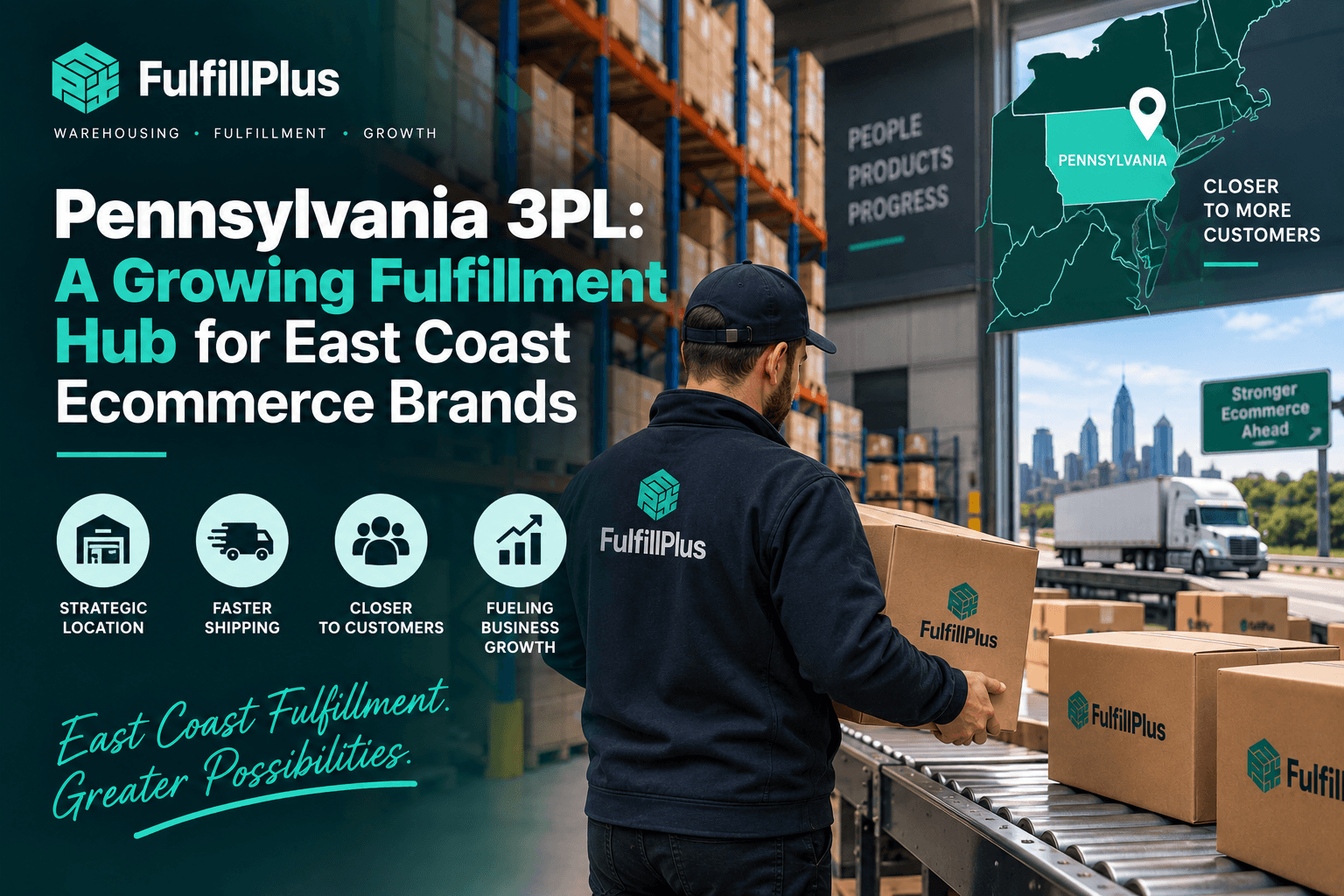
If you’ve ordered something online in the last few years and it arrived faster than you expected, there’s a decent chance it passed through Pennsylvania on the way to you. Amazon, Walmart, and dozens of major 3PLs have built out warehouse capacity across the state, and it’s not a coincidence. Pennsylvania sits at one of the most useful intersections in American logistics, and that’s turned it into one of the country’s busiest hubs for e-commerce fulfillment services.
For brands trying to decide where to position inventory, understanding why Pennsylvania keeps showing up on every serious 3PL’s location list is worth five minutes of reading.
Why Pennsylvania Became an E-Commerce Fulfillment Hub
The short answer is geography. Pennsylvania sits within a day’s drive of roughly a third of the U.S. population, with direct highway access to New York City, Philadelphia, Washington D.C., Baltimore, and the rest of the Northeast corridor. That’s a huge concentration of e-commerce demand sitting within a tight radius.
A handful of factors compound that advantage:
- Interstate access. Major highway corridors running through the state connect fulfillment centers directly to the densest population centers on the East Coast, which keeps ground shipping times short.
- Port and rail proximity. Inbound freight arriving through East Coast ports can reach Pennsylvania warehouses quickly, which matters for brands importing inventory before it goes out to customers.
- Labor availability. Decades of warehouse and logistics investment in the state means an established workforce already trained on modern fulfillment operations.
- Room to build at scale. Compared to warehouse space directly inside major metro areas, Pennsylvania offers large facility footprints at a lower cost, which keeps operating costs down for the fulfillment providers using it.
Put together, this is why so many e-commerce fulfillment centers cluster in Pennsylvania instead of trying to operate directly out of New York City or Philadelphia proper. Real estate and labor costs inside those metro areas make large-scale fulfillment operations expensive to run, while a facility an hour or two outside the city gets nearly the same delivery speed at a fraction of the overhead, a savings that tends to get passed along as more competitive fulfillment pricing.
What a Pennsylvania 3PL Actually Solves
Location matters most when it changes something concrete for your customers and your bottom line. For brands shipping to the East Coast, a Pennsylvania-based fulfillment center typically solves three problems.
1. Shorter Transit Times to the Densest Markets
Positioning inventory in Pennsylvania puts a fulfillment center within one to two days of ground shipping to New York City, Philadelphia, New Jersey, Maryland, and the wider Tri-State region. For a brand whose customer base skews East Coast, that’s the difference between a 2-day delivery promise you can actually keep and one that only works some of the time.
| Destination | Approx. Ground Transit from PA | From a West Coast Warehouse |
|---|---|---|
| New York City, NY | 1 day | 4–5 days |
| Philadelphia, PA | Same day–1 day | 4–5 days |
| Washington, D.C. | 1 day | 4–5 days |
| Baltimore, MD | 1 day | 4–5 days |
| Boston, MA | 1–2 days | 5 days |
Transit times are general estimates for standard ground shipping and vary by carrier, exact origin, and destination address.
2. Lower Shipping Zone Costs
Carrier pricing is based on shipping zones, and zones are based on distance. A package traveling from a West Coast warehouse to a New York customer crosses far more zones, and costs more, than the same package shipped from a Pennsylvania facility. At meaningful order volume, that difference adds up fast.
3. A Foundation for Multi-Region Coverage
Most brands don’t rely on a single warehouse forever. Pairing a Pennsylvania location with fulfillment centers in other regions, such as the West Coast or Central U.S., builds toward the kind of nationwide reach that lets a brand ship to nearly any customer within one to two days rather than relying on one warehouse to cover the whole country.
A brand that starts with a single Pennsylvania warehouse and later adds West Coast coverage doesn’t have to rebuild its fulfillment strategy from scratch. Inventory can be split by region, cutting average transit times nationwide instead of just improving them for one area while leaving the rest unchanged.
4. Better Resilience During Peak Season and Disruptions
A single-warehouse setup means a regional weather event, a carrier slowdown, or a spike in local order volume can bottleneck your entire fulfillment operation. Splitting inventory between a Pennsylvania facility and at least one other region means a disruption in one area doesn’t necessarily stall orders everywhere else. That matters most exactly when it’s hardest to plan around: the weeks leading into a holiday peak, when both order volume and weather risk are at their highest.
What to Look for in an E-Commerce Fulfillment Center in Pennsylvania
Not every Pennsylvania warehouse is set up the same way, and the differences matter once you’re actually shipping through one. Before committing inventory to any e-commerce fulfillment centers in the state, it’s worth confirming:
- Exact location relative to your customer base. Pennsylvania is a large state; a facility near the New York/New Jersey border serves a different set of customers than one further west.
- Platform integrations. Direct connections to Shopify, Amazon, Walmart, TikTok Shop, and Etsy remove manual order entry and reduce fulfillment errors.
- Order accuracy and processing speed. Ask for real numbers, not general claims. A facility processing orders within 24 hours with high accuracy rates is a different experience than one that only hits those numbers outside of peak season.
- Specialized handling capabilities. Kitting, subscription box fulfillment, retail replenishment, and DTC order fulfillment aren’t offered identically everywhere. If your brand needs one of these, confirm it’s a core capability, not an add-on.
- Fee structure. Transparent, predictable pricing matters more once volume grows. Hidden per-order fees or required monthly minimums can quietly erase the cost advantage of choosing a well-located warehouse in the first place.
| What to Check | Why It Matters |
|---|---|
| Exact facility location | Determines actual transit times to your specific customer base |
| Platform integrations | Reduces manual order entry and fulfillment errors |
| Order accuracy rate | Directly affects customer satisfaction and return rates |
| Processing speed (peak vs. standard) | Reveals whether performance holds up during high-volume periods |
| Specialized services offered | Confirms fit for DTC, subscription, wholesale, or retail needs |
| Fee transparency | Protects margin as order volume scales |
FulfillPlus operates a Pennsylvania facility in Olyphant, positioned to reach New York City, Philadelphia, New Jersey, Maryland, and the broader Tri-State region, as part of a three-warehouse network built to reach the large majority of the U.S. population within one to two days of ground shipping. The facility supports DTC, wholesale, and retail replenishment fulfillment, with the same accuracy and fee-transparency standards applied across every FulfillPlus location.
Is a Pennsylvania 3PL the Right Fit for Your Brand?
A Pennsylvania-based e-commerce fulfillment center tends to make the most sense when:
- A meaningful share of your order volume ships to the Northeast or Mid-Atlantic
- Your current shipping times to East Coast customers are longer than you’d like
- You’re evaluating a second or third warehouse location to build out nationwide coverage
- Rising shipping zone costs are eating into margin on East Coast orders
- You’re preparing for a peak season where fast delivery to dense population centers matters most
If several of these apply, it’s worth taking a closer look at how a Pennsylvania location fits into your broader e-commerce fulfillment strategy, whether that’s your first outsourced warehouse or an addition to a network you’re already running.
It’s also worth thinking about how this fits into the fulfillment services you’ll actually use day to day. A brand running a Shopify store, a subscription box program, or an apparel line with frequent size and SKU changes has different operational needs than a wholesale-heavy business focused on retail replenishment. A Pennsylvania facility that supports DTC, wholesale, and retail fulfillment under one roof means you’re not stuck choosing between coverage and capability.
Final Thoughts
Pennsylvania’s rise as a fulfillment hub isn’t a trend so much as a function of geography that isn’t going away. For brands with real East Coast order volume, positioning inventory there is one of the more straightforward ways to shorten delivery times and reduce shipping costs without a major operational overhaul.
Want to see what a Pennsylvania-based fulfillment strategy could look like for your brand? Contact FulfillPlus to talk through your order volume, customer locations, and where inventory should sit to serve them best.