
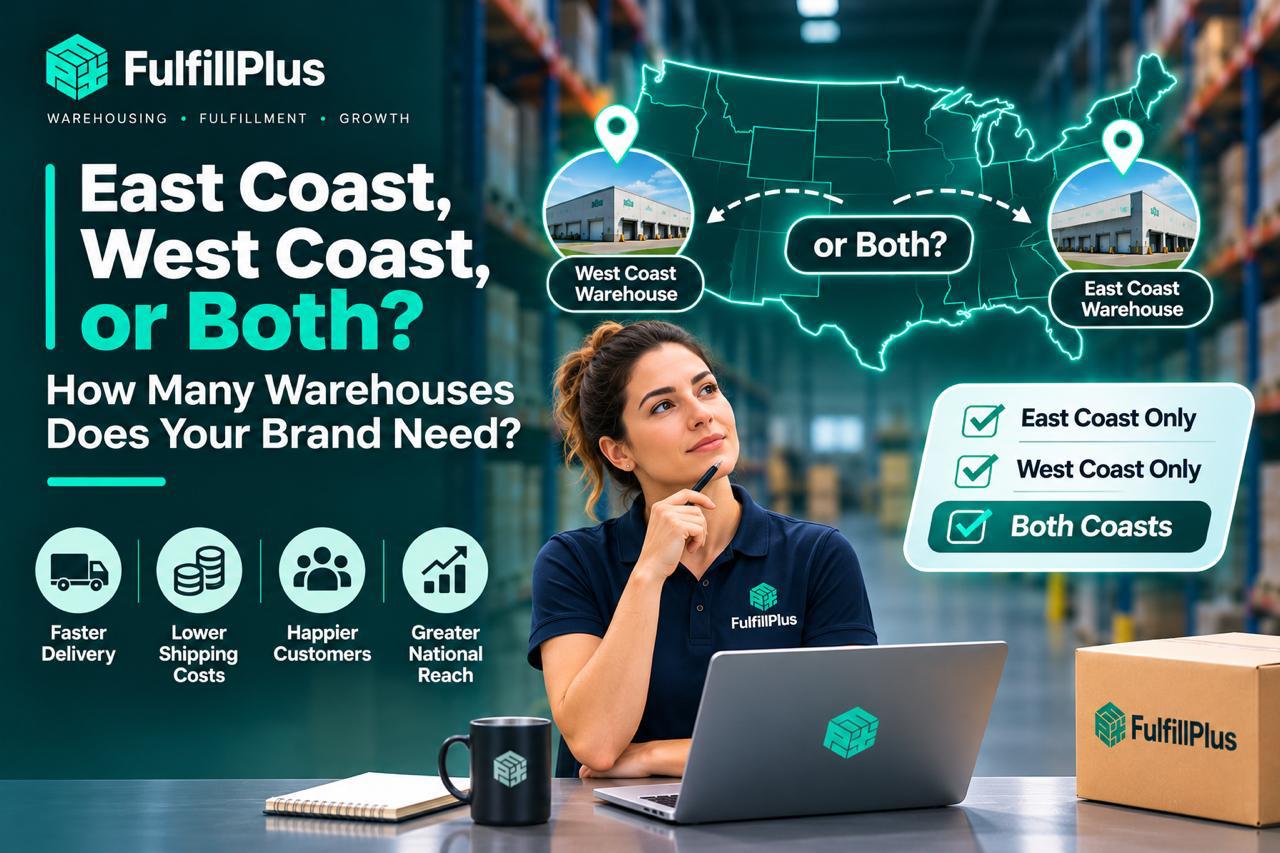
East Coast, West Coast, or Both? How Many Warehouses Does Your Brand Need?
Most brands start with one fulfillment warehouse, and for a while that works. Then orders start landing in places the warehouse is far from. Customers in California wait five days for a package from Pennsylvania, or customers in New York wait for one from Fremont, and someone on your team asks whether it’s time for a second location.
Multi-warehouse fulfillment can cut delivery times and postage, but it isn’t free. Splitting inventory adds stock you have to carry, more inbound shipments, and new ways for things to go wrong. This guide gives you a way to decide with your own order data instead of a guess: how shipping zones work, what a second location actually costs, and a break-even formula you can run in a spreadsheet.
Start with where your orders actually go
Carriers price and time ground shipments by zone, which is a distance band between the warehouse ZIP code and the delivery ZIP code. UPS and FedEx use zones 2 through 8 across the contiguous states. The farther a parcel travels, the more it costs and the longer it takes.
| Zones | Rough distance from the warehouse | Typical ground transit (business days) |
|---|---|---|
| 2–3 | up to about 300 miles | 1–3 |
| 4–5 | about 300–1,000 miles | 2–4 |
| 6–8 | 1,000+ miles (zone 8 is 1,800+) | 3–5 |
These are ranges, not promises. Sources differ on the details, carriers publish their own time-in-transit maps for each origin ZIP, and actual transit depends on the lane. But the pattern holds. A coast-to-coast parcel from a single warehouse is a zone 8 shipment that typically takes four to five business days, while the same parcel from a warehouse on the right coast might be a zone 4 or 5.
Before you think about locations, pull the last 90 days of orders and group them by destination ZIP. You’re looking for one number: what share of your orders land in zones 7 and 8 from your current warehouse. That share is what a second location could actually improve.
What your options look like
| Setup | Best for | Watch out for |
|---|---|---|
| One East Coast warehouse | Brands with the most customers in the Northeast and Mid-Atlantic | Slow, costly shipments to the West |
| One West Coast warehouse | Brands with the most customers west of the Rockies, or inbound freight landing at West Coast ports | Slow, costly shipments to the East |
| One central warehouse | Brands with customers spread widely, or are heavy in Texas, the South, and the Midwest | Neither coast gets the fastest routes |
| East plus West | Brands with real demand on both coasts | Carrying inventory in two places |
| East, central, and West | High-volume brands that sell nationally and promise fast delivery | More buffer stock and more coordination |
There’s no single right answer. The right setup is whichever one shortens the zones for the largest share of your orders without costing more than it saves.
What multi-warehouse fulfillment really costs
The savings are easy to picture: shorter zones, lower postage, faster delivery. The costs are less obvious.
More safety stock. Safety stock is the extra inventory you hold to avoid selling out. When one pool of inventory splits into two, each location needs its own buffer, because a surge at one can’t draw on stock sitting at the other. Under the standard square-root rule from inventory theory, total safety stock grows by roughly the square root of the number of locations. With two locations, that’s about 41% more buffer. With three, about 73%. The rule assumes demand is split evenly and varies independently between locations, so treat it as a rough guide rather than a forecast.
More inbound freight. You’re now sending replenishment to two places. Smaller shipments to each location usually cost more per unit than one large shipment to one.
Split shipments. If an order includes two items and each sits in a different warehouse, you either ship it in two packages (paying postage twice) or hold it while stock moves. Brands with bundles and multi-item orders feel this most.
Forecasting by region. You now need to predict demand by region, not just in total. A product that sells well in New York and poorly in Los Angeles will run short in one place and sit unsold in the other.
Operational overhead. Returns need a rule for which warehouse receives them. Inventory counts, reorder points, and transfers between locations all need an owner.
A break-even formula you can run yourself
The question to answer is whether the postage you’ll save is greater than the extra cost of holding a second location.
Break-even orders per month = monthly added cost of the second warehouse ÷ postage saved per order shipped from it.
Here’s an illustration. The inputs are assumptions, so replace them with your own numbers from carrier rate cards and your 90-day order data.
| Input | Assumed value |
|---|---|
| Total orders per month | 3,000 |
| Share going to the western half of the country | 35% (1,050 orders) |
| Postage saved per western order shipped from a West node | $2.00 |
| Extra pallets held to buffer the split | 8 pallets |
| Storage per pallet, per month | $19.37 (2026 survey average) |
| Receiving the extra pallets | $8.75 per pallet (2026 survey average) |
| Extra inbound freight to the second location | $400 per month |
| Line | Math | Monthly |
|---|---|---|
| Postage savings | 1,050 orders × $2.00 | +$2,100.00 |
| Extra storage | 8 × $19.37 | −$154.96 |
| Extra receiving | 8 × $8.75 | −$70.00 |
| Extra inbound freight | assumed | −$400.00 |
| Net monthly benefit | +$1,475.04 |
The break-even point is $624.96 of added cost divided by $2.00 saved per order, or about 313 western-bound orders a month. At a 35 percent western share, that’s roughly 890 total orders. Below that, a second warehouse costs more than it saves in postage.
Two cautions. First, the $2.00 saving is a placeholder. The real figure is the difference between your current zone rates and the rates from the second location, so get it from your carrier rate card rather than guessing. Second, this ignores everything that isn’t postage: faster delivery can lift conversion and repeat purchases, while split shipments and forecasting errors can eat into the gain. The formula tells you whether the postage math is close, not whether the decision is right.
Rules of thumb for a first read
Use these to decide whether the formula is worth running, not to settle the question.
- If one warehouse already reaches the large majority of your orders in zones 2 through 4, a second location rarely pays for itself.
- If a third or more of your orders land in zones 7 and 8, a second location deserves a serious look.
- If most of your inbound freight lands at one coast’s ports, put your first warehouse near it to cut the truck move from port to warehouse.
- If your volume is small, one well-placed warehouse is almost always the better choice. Wait until the break-even number is comfortably below what you ship.
Questions to ask a 3PL about multiple locations
Not every provider handles multi-warehouse fulfillment the same way. Before you commit, get clear answers on these.
- Can I see inventory by location in one dashboard?
- How are orders routed to a location, and can I set the rules?
- What happens when one order includes items stocked in different warehouses?
- How are transfers between your locations billed?
- Are there separate storage minimums or fees for each location?
- Which location receives returns, and can I choose?
- How do you handle a stockout at one location while another still has stock?
If a provider can’t answer these clearly, you’ll likely find out why after you’ve split your inventory.
How this looks with FulfillPlus
FulfillPlus operates fulfillment centers in Pennsylvania, Texas, and California, with 2-day ground shipping across the mainland U.S. That gives a brand several ways to set up: one location placed where most orders go, two locations on opposite coasts, or a central base with room to add a coast later. See the coast-to-coast coverage page for how the network fits together.
FulfillPlus also has no monthly minimums, which matters here. A second location shouldn’t force you into a fixed monthly bill before your volume can support it.
Final thoughts
The right number of warehouses isn’t a rule about brand size. It’s a result you get from your own orders: where they ship, what the zones cost you today, and whether the savings from a second location beat the stock and handling it adds. Start with 90 days of ZIP-level order data, run the formula with real carrier rates, and add a location when the math says so, not when it feels like time.
If you’d like to talk through your order map and what a one-, two-, or three-location setup would mean for your inventory, contact FulfillPlus with your monthly orders and where they ship.