
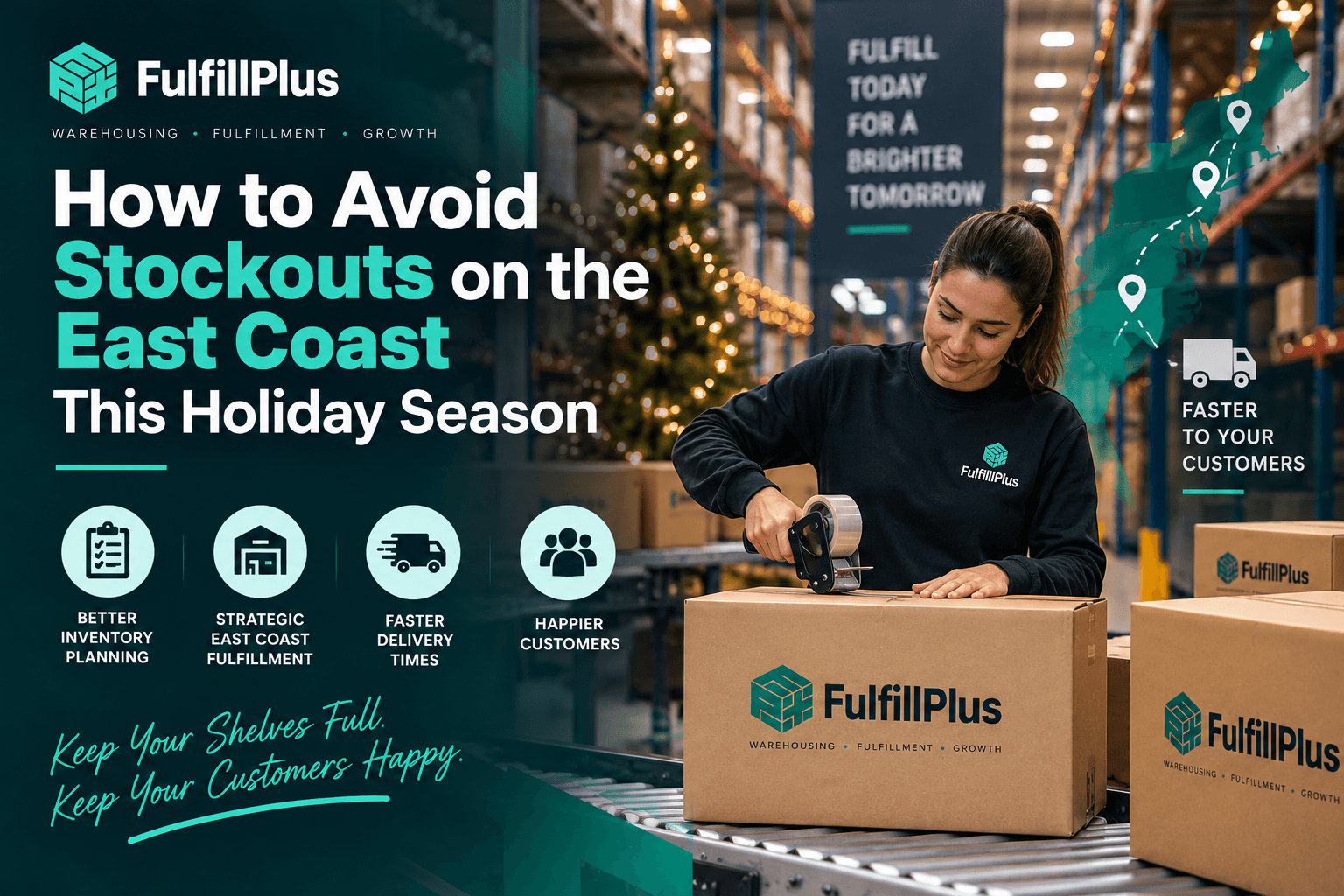
Labor Day has come and gone, which means the holiday shopping season is closer than it feels. If you sell to customers on the East Coast, now is the time to lock in inventory and shipping plans before demand spikes and carrier capacity tightens up. Brands that wait until Black Friday week to think about stock levels are usually the ones scrambling to explain sold-out listings in December.
Here’s how to avoid stockouts this holiday season, with a specific focus on East Coast fulfillment and the inventory decisions that matter most right now.
Why the East Coast Needs Its Own Plan
Roughly a third of the U.S. population lives in the Northeast and Mid-Atlantic corridor, from Boston down through Washington, D.C. That density means a huge share of holiday order volume is concentrated in a relatively small geographic area, and it also means winter weather can shut down delivery routes for days at a time.
If your inventory sits in a single warehouse on the West Coast or in the Midwest, every East Coast order has to travel farther, through more transfer points, with more chances for delays. During the holiday crunch, that extra transit time is exactly what can turn a minor inventory shortfall into a stockout, because there’s no buffer left to reroute or restock in time.
Positioning inventory in an East Coast fulfillment center shortens that distance. Orders can ship in 1–2 days instead of 4–5, which means you can run closer to the wire on restocks without customers noticing the difference.
What Causes Stockouts During the Holidays
Most holiday stockouts trace back to one of a few root causes:
- Forecasts based on last year’s numbers alone, without accounting for growth, new products, or a bigger ad budget
- Reorder lead times that don’t match supplier reality, especially for anything manufactured overseas
- Inventory spread too thin across sales channels, so a bestseller sells out on one marketplace while units sit idle in another warehouse
- No visibility into real-time stock levels, so by the time a low-inventory alert goes out, it’s already too late to reorder
- Underestimating a single viral moment, like a product going viral on TikTok in the middle of Q4
Any one of these can knock out your bestselling SKU on December 10th, right when order volume is at its peak and there’s no time left to recover.
Holiday Inventory Management Strategies That Actually Work
1. Forecast by SKU, Not Just Total Revenue
A revenue forecast tells you almost nothing about which specific products will run out. Break your forecast down by SKU and sales channel, then compare it against your current lead times. If a product takes six weeks to restock and you’re already inside that window, it needs attention now, not after Thanksgiving.
2. Build in a Buffer for Your Top 20% of SKUs
The 80/20 rule holds true for most e-commerce catalogs: a small number of products drive most of the revenue. Those are the SKUs where a stockout hurts the most, so they deserve the largest safety stock buffer. Slower-moving items can run leaner.
3. Get Inventory Into an East Coast Warehouse Before October
Shipping inventory to a fulfillment center takes time, and freight capacity gets tighter as the holidays approach. Getting stock positioned in an East Coast warehouse in September or early October avoids the inbound bottleneck that hits everyone who waits until November.
4. Set Low-Stock Alerts You’ll Actually Act On
A dashboard buried in a system nobody checks doesn’t prevent stockouts. Set alerts at a threshold that gives you enough lead time to reorder and receive inventory before you hit zero, and make sure someone is actually responsible for acting on them during Q4.
5. Coordinate Inventory Across Every Sales Channel
If you sell on Shopify, Amazon, TikTok Shop, and Walmart at the same time, your inventory management needs to see all of it in one place. A fulfillment partner with integrations across these platforms can prevent the common scenario where one channel oversells while another sits on excess stock.
How East Coast Fulfillment Reduces Stockout Risk
Beyond shorter transit times, East Coast fulfillment centers help prevent stockouts in a few concrete ways:
- Faster replenishment cycles. Shorter shipping distances mean restocked inventory reaches customers faster, so you can run tighter inventory levels without the same risk.
- Regional demand absorption. Splitting inventory between coasts means a shortage in one region doesn’t automatically become a nationwide stockout.
- Real-time inventory visibility. A good fulfillment partner gives you a live view of stock levels, order velocity, and reorder points, so you’re reacting to actual data instead of guessing.
- Faster peak-season processing. Orders placed during the holiday crunch still need to move through receiving, picking, and packing quickly. A fulfillment center built for volume keeps that pipeline from backing up when order counts triple overnight.
At FulfillPlus, East Coast fulfillment centers are part of a coast-to-coast network built specifically to handle this kind of seasonal swing, with orders processed within 24 hours and a 99.99% accuracy rate even during peak volume. There are no hidden fees or monthly minimums either, so scaling up inventory for Q4 doesn’t come with a surprise bill in January.
The Timeline: What to Do and When
- Mid-September: Finalize SKU-level holiday forecasts and identify your top-risk products
- Late September: Place reorders for anything with a lead time longer than six weeks
- Early October: Get inventory positioned in East Coast warehouses ahead of peak freight demand
- Mid-October: Set or review low-stock alert thresholds across all sales channels
- November: Monitor daily, not weekly, and be ready to reallocate stock between regions if one is moving faster than expected
Final Thoughts
Avoiding stockouts during the holiday season isn’t about predicting the future perfectly. It’s about shortening the distance between a problem and your ability to fix it. Positioning inventory closer to your East Coast customers, tightening up your forecasting, and getting real-time visibility into stock levels all buy you the reaction time that a single, centralized warehouse can’t.
If your current setup doesn’t give you East Coast coverage, September is the month to change that before peak season locks in shipping and warehouse capacity. Contact FulfillPlus to talk through your holiday inventory plan and get products positioned where your customers actually are.