
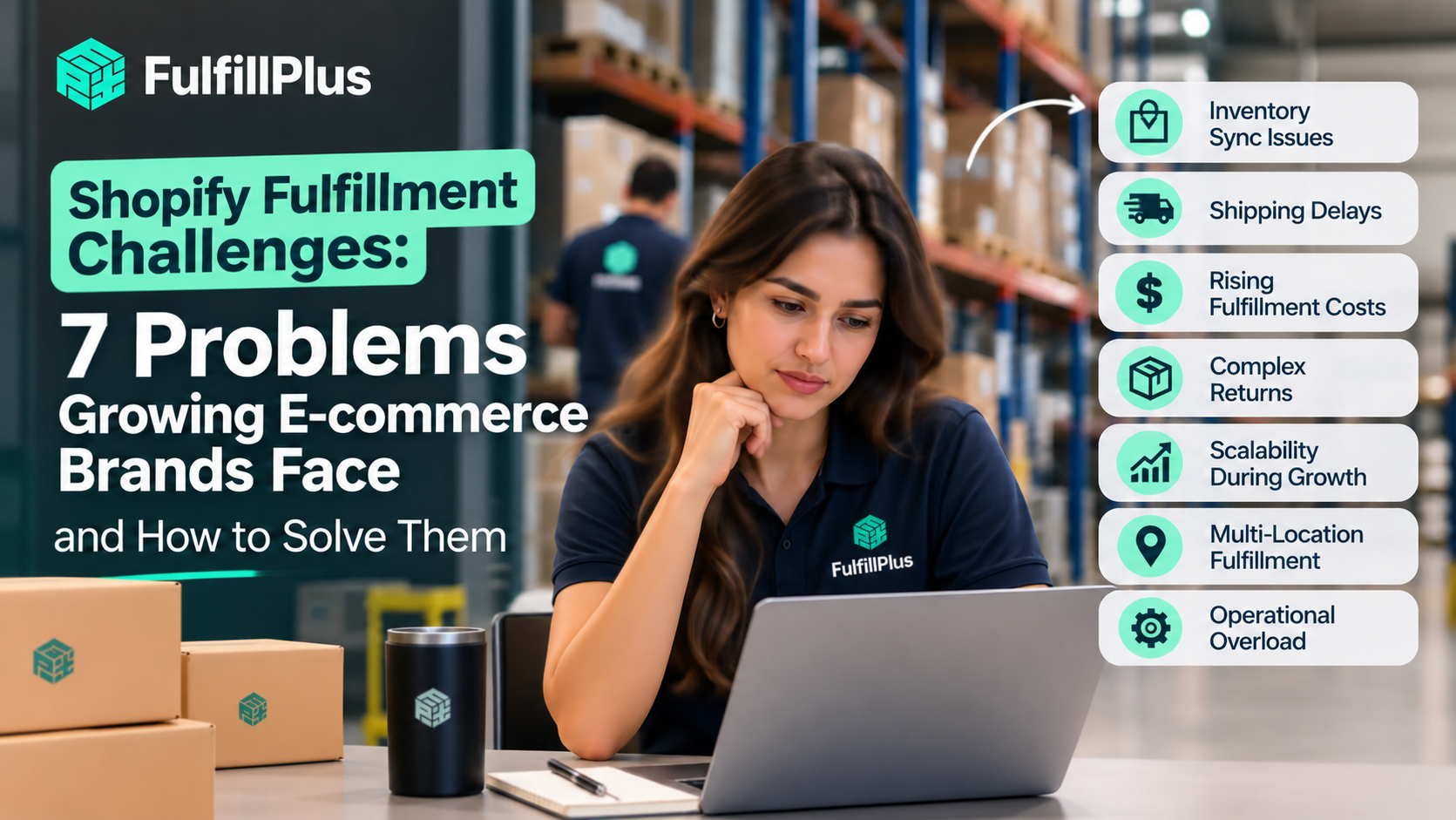
Shopify Fulfillment Challenges: 7 Problems Growing E-commerce Brands Face and How to Solve Them
Shopify makes it easy to launch a store. It does not make it easy to pack, ship, and track hundreds of orders a week.
For most brands, the problem shows up right after the first serious ad spend or the first real holiday season. Sales climb, and then the cracks appear: late parcels, wrong items, stock that says “available” when the shelf is empty, and shipping bills that keep growing.
The good news is that these problems are common, predictable, and fixable. This guide walks through the 7 biggest Shopify fulfillment challenges growing brands face and how professional e-commerce fulfillment services help solve each one.
Why Shopify Fulfillment Gets Harder as You Grow
Shopify handles your storefront, checkout, and order data very well. What happens after the “Buy” button, storing products, picking, packing, shipping, and handling returns, is a separate operation, and it does not scale on its own.
Many Shopify fulfillment guides point to a rough tipping point: somewhere between 100 and 300 orders a month, doing it yourself starts to eat the time you should spend on marketing and product. Your own numbers may differ, but the pattern is the same. Demand arrives before the operation is ready, and customers feel the gap in late deliveries and slow replies.
That is where Shopify order fulfillment support from a third-party logistics (3PL) partner comes in. A 3PL stores your inventory, receives orders from your store automatically, and ships them for you. If you want the full basics first, read our E-commerce Fulfillment Guide.
Problem 1: Slow Shipping and Missed Delivery Promises
What happens: Customers now compare every store to the fastest one they have ordered from. If your orders ship a few days late, or travel across many shipping zones from one location, you get “Where is my order?” emails, refund requests, and bad reviews.
Why it happens:
- Orders are packed by hand, in batches, when you have time.
- All inventory sits in one place, far from many customers.
- There is no clear cut-off time for same-day shipping.
How to solve it:
- Set a clear processing promise, such as same-day shipping for orders placed before a cut-off time.
- Store inventory closer to where your customers live. A 3PL with several warehouses can reduce transit times and shipping zones.
- Automate order flow so that Shopify sends orders to the warehouse in real time, with tracking sent back to the customer.
How FulFillPlus helps: With warehouses on the West Coast, in Houston, and on the East Coast, we offer two-day ground reach across the mainland US and same-day shipping, so your delivery promise is one you can keep.
Problem 2: Inventory Errors, Overselling, and Stockouts
What happens: A customer buys the last item, but it is not really in stock. Or the opposite: stock sits unsold because it was counted wrong. Both are expensive.
Why it happens: Shopify gives you solid inventory tracking and multi-location features, but accuracy depends on what is physically happening in the warehouse. Manual counts, products stored in several places, and orders from multiple channels can all push your numbers out of sync. As you add SKUs, warehouses, and sales channels, Shopify inventory management becomes a bigger job than the built-in tools alone are designed to handle.
How to solve it:
- Use barcodes or SKU labels on every product and bin.
- Run regular cycle counts instead of one big count a year.
- Choose a fulfillment partner with a warehouse management system that updates stock as items are received, picked, and returned.
- Set low-stock alerts so you can reorder before you sell out.
How FulFillPlus helps: We offer total visibility and inventory control, with a 99.99% order accuracy rate, so what you see in your dashboard matches what is on the shelf.
Problem 3: Rising Shipping Costs That Eat Your Margins
What happens: Shipping becomes your biggest cost after the product itself, and the cost keeps going up.
Why it happens: UPS and FedEx both announced a 5.9% average general rate increase for 2026. But the headline number is only part of the story. Carriers have also raised surcharges for residential delivery, delivery areas, and oversized or heavy packages, and package dimensions now play a bigger role in how those surcharges are charged. Industry analysts estimate the real-world cost increase for many shippers is well above the headline figure, depending on what and where they ship.
Poor packaging adds to the problem. Even a slightly oversized box can raise the billed weight.
How to solve it:
- Right-size your packaging. Use boxes that fit the product, not the biggest one on hand.
- Compare carriers and services for each order type, not just one carrier for everything.
- Shorten the distance packages travel by storing inventory closer to customers.
- Ask your 3PL to explain surcharges clearly on every quote and invoice.
How FulFillPlus helps: We focus on optimized freight cost and give you clear pricing with no hidden fees and no monthly minimums. You can see more on our e-commerce fulfillment services page.
Problem 4: You Are Spending Your Day Packing Boxes
What happens: The founder, or a few team members, spend hours every day printing labels, picking items, taping boxes, and driving to the post office. Growth stalls because nobody has time for it.
Why it happens: Self-fulfillment works at low volume. As orders climb, it takes more space, more people, more supplies, and more management. The hours you spend packing are hours you are not spending on marketing, product development, or customers.
How to solve it:
- Track how many hours per week you spend on fulfillment tasks. Multiply it by what your time is worth.
- Compare that to what outsourcing would cost.
- Move to a 3PL when the cost of your time and space is higher than the cost of outsourced fulfillment.
How FulFillPlus helps: We receive your inventory, store it, pick and pack every order, and ship it. You can also add services such as kitting, relabeling, custom printing, and branded packaging.
Problem 5: Peak Season and Sales Spikes Break Your Process
What happens: A viral post, a big sale, or Black Friday and Cyber Monday bring ten times your normal orders. Your process cannot flex, so orders back up and customers wait.
Why it happens: An in-house operation is built for average days, not peak days. Hiring and training temporary workers takes time, and mistakes rise when people rush.
How to solve it:
- Forecast demand and send inventory to your warehouse early.
- Share your promotion calendar with your 3PL so they can plan labor and space.
- Use a partner with flexible capacity and no long-term contracts.
- Make sure your inbound shipments are labeled and prepared correctly before they arrive.
How FulFillPlus helps: We built our operation to scale up and down with your business. With no monthly minimums, you are not paying for capacity you do not use during slower months.
Problem 6: Selling on Several Channels Gets Messy
What happens: You start on Shopify, then add Amazon, Walmart, Etsy, or TikTok Shop. Soon you are managing different orders, different rules, and stock levels that do not match across channels.
Why it happens: Each channel has its own order format, shipping rules, and performance standards. Without one central system, orders get missed, inventory is oversold, and tracking updates arrive late.
How to solve it:
- Keep one pool of inventory that feeds all channels.
- Choose a 3PL that integrates with your Shopify store and your other sales channels in a single dashboard.
- Check that tracking updates go back to each marketplace automatically.
How FulFillPlus helps: We integrate with major platforms including Shopify, Amazon, Walmart, TikTok Shop, Etsy, WooCommerce, Wix, Squarespace, and Volusion. View all integrations. If you want more control than Amazon FBA gives you, see our FBA alternative.
Problem 7: Returns Pile Up and Tie Up Your Cash
What happens: Returned items arrive in random boxes at your house or office. They are not checked, not restocked, and not refunded quickly. Sellable products sit idle while customers wait for their money back.
Why it happens: Returns are often treated as an afterthought, with no process for receiving, inspecting, and sorting items.
How to solve it:
- Set a clear returns policy and make it easy to find.
- Use prepaid return labels or a returns portal so every return is tracked.
- Inspect and grade returned items quickly: restock, repair, repackage, or dispose.
- Review return reasons every month to find product or listing problems.
How FulFillPlus helps: We receive, inspect, and process your returns so that sellable items return to stock quickly. Learn more about our reverse logistics services.
How to Choose the Right Shopify Fulfillment Solution
Not every 3PL is built for Shopify brands. Some focus on wholesale, some on Amazon, and some add Shopify support on top of an older system. Use this checklist when comparing Shopify fulfillment solutions:
| What to check | Why it matters |
|---|---|
| Native Shopify integration | Orders and tracking sync automatically, with no manual entry |
| Warehouse locations | Closer inventory means faster, cheaper Shopify shipping and fulfillment |
| Order accuracy rate | Fewer wrong items means fewer refunds and complaints |
| Same-day shipping cut-off | Sets a clear promise for your customers |
| Pricing transparency | Avoids surprise fees, minimums, and long-term contracts |
| Inventory visibility | Lets you see stock and orders in real time |
| Multi-channel support | Lets you add Amazon, Walmart, TikTok Shop, and more as you grow |
| Value-added services | Kitting, custom packaging, relabeling, and returns processing |
| Support | A real person who answers when something goes wrong |
Signs It Is Time to Move to a 3PL
- You are processing more orders than you can pack on time.
- Customers complain about shipping speed.
- Inventory counts are often wrong.
- Shipping costs are growing faster than sales.
- You sell on more than one channel.
- Holiday seasons stress your whole team.
- Your product storage is taking over your home or office.
If you recognize three or more, it is likely time to explore third-party logistics (3PL) options.
Frequently Asked Questions
What are Shopify fulfillment services?
Shopify fulfillment services are third-party providers that store your inventory, receive orders from your Shopify store, then pick, pack, and ship them to your customers. They also handle returns and update tracking information for you.
How do I connect my Shopify store to a 3PL?
Most 3PLs connect through an app or integration. Once connected, new orders flow to the warehouse automatically, and tracking details go back to Shopify when each order ships. Your 3PL will guide you through setup.
When should a Shopify store start using a fulfillment company?
Many brands begin looking when they reach about 100 to 300 orders a month, or sooner if packing takes too much time, shipping is slow, or inventory is hard to manage. The right time is when fulfillment starts limiting growth.
How much do Shopify fulfillment services cost?
Costs usually include receiving, storage, pick and pack, packaging materials, shipping, and any special services. Pricing differs from one provider to another, so ask for a full quote and check for hidden fees and monthly minimums.
Can a 3PL ship orders from Shopify and Amazon together?
Yes. A good 3PL connects to all of your sales channels and keeps one pool of inventory, so you can sell in several places without stock mismatches.
Will a 3PL let me keep my brand experience?
Yes. You can use branded boxes, inserts, thank-you cards, and custom packaging, so customers still feel they are ordering directly from you.
Final Thoughts
Growing pains in fulfillment are a sign that your brand is working. But left unsolved, slow shipping, wrong inventory, rising costs, and messy returns can hold back everything you have built.
The right e-commerce fulfillment services partner takes this load off your shoulders, so you can focus on products, marketing, and customers.
FulFillPlus offers Shopify-ready fulfillment with multiple US locations, two-day ground reach, no hidden fees, and no monthly minimums.
Contact us today for a quote and see how simple fulfillment can be.